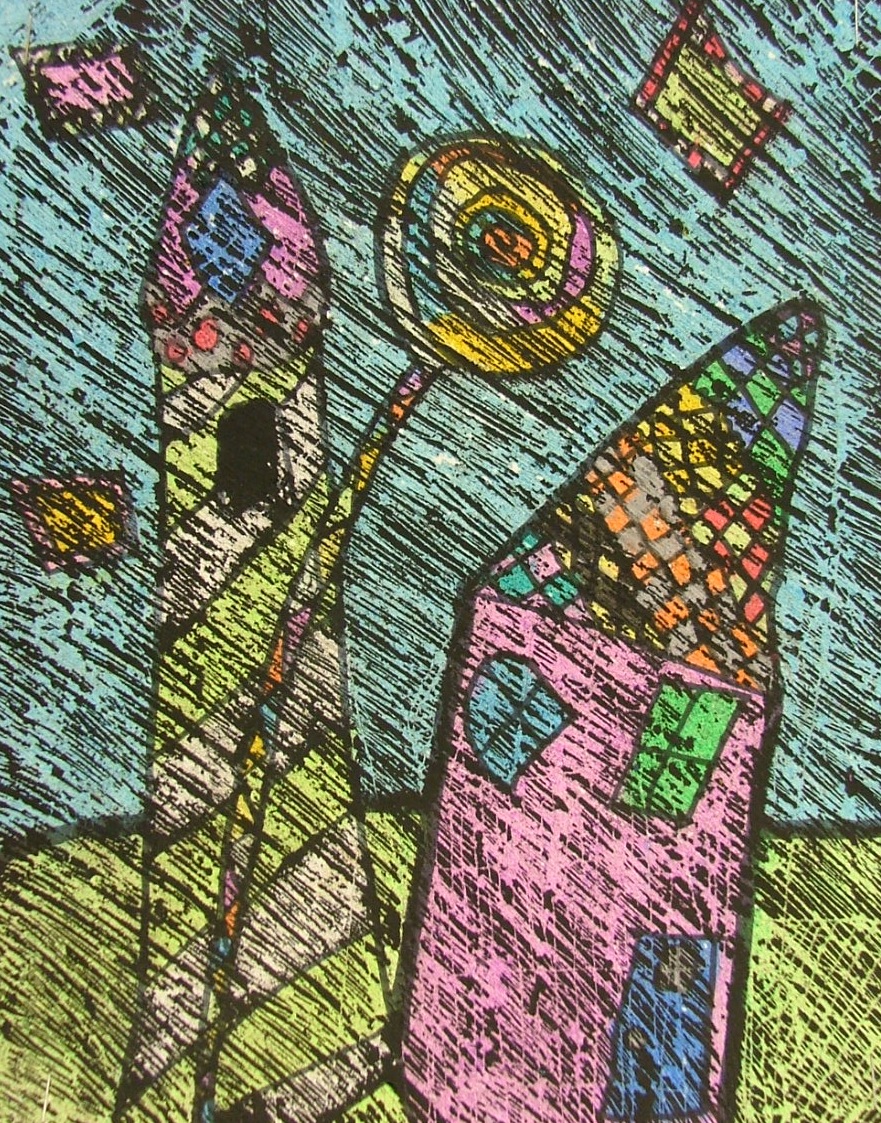
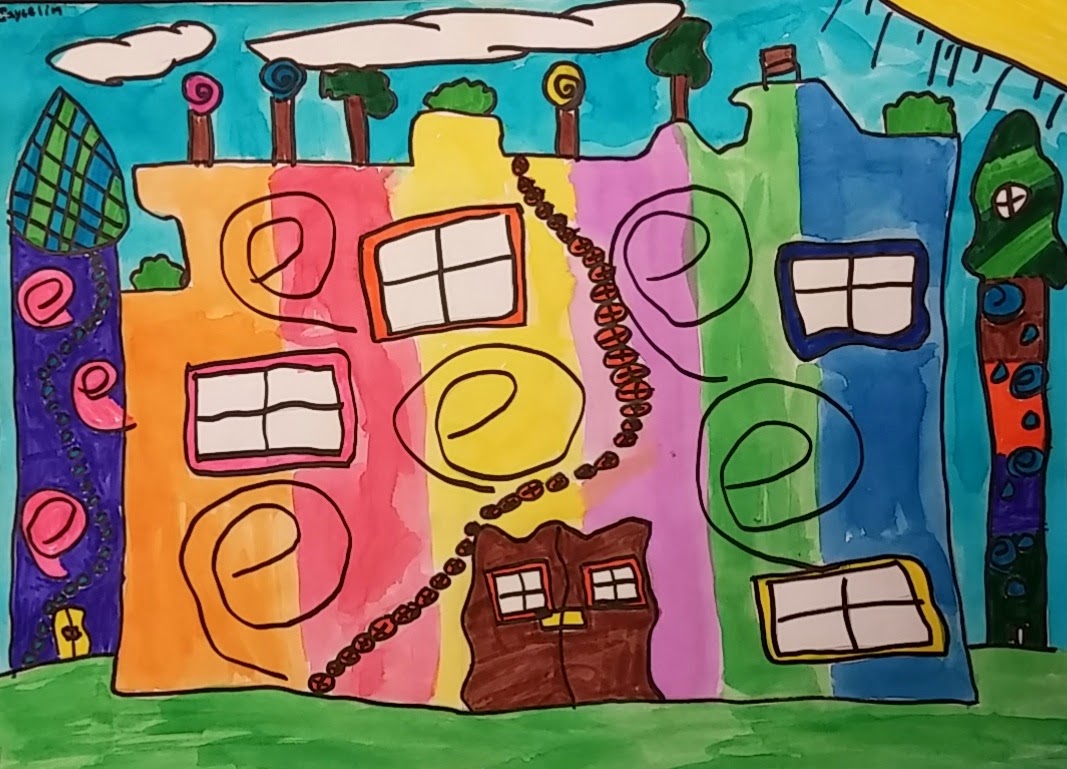
Each year our fifth graders learn about the art of painter and architect: Friedrich Hundertwasser. Hundertwasser is a whimsical artist who really is amazingly creative. Some classes were able to learn more about Hundertwasser through the book Hundertwasser for Kids: Harvesting Dreams. This book gives a playful peak into the mind of the artist!
After looking at artwork created by Hundertwasser, we came up with a list of common characteristic: colorful, buildings, faces, and lollypop trees. We used these characteristics to help guide our designs.
Learning Goals: I can...
- Tell about Hundertwasser
- Balance color
- Use etching lines to create texture
- Explain what architecture is
Fifth grade students learned about the artist Friedensreich Hundertwasser. He was a highly creative painter, architect and philosopher from Austria. After analyzing his artwork, students helped create a list of common characteristics in Hundertwasser's artwork:
Common Characteristics:
Subjects:
- Faces
- Buildings
- Plants
Art Elements/ Principles:
- Line: curving, especially spirals
- Pattern: shapes and colors
- Colorful
- Variety
Most classes came up with a basic list like the one above. We used this list to create requirements for our Hundertwasser artwork. Students completed 2 thumbnail sketches of their architectural plans and consulted with me about layout and details before moving on with their favorite on the final paper. During work time, I read the book Hundertwasser for Kids: Harvesting Dreams.
This is a fantastic book that really gives a window into the philosophies of Hundertwasser and shows how his thinking impacted his artwork and architecture. He was an artist who strongly believed in uniqueness, imperfection and the importance of nature. All of the classes enjoyed listening to this book while coloring and painting their own unique masterpieces! The kids loved the freedom and creativity that this project involved... and lets face it that is how Hundertwasser would have wanted it!
Learning goals: I can...
- Tell about Hundertwasser
- Explain what an architect does
- Create my own unique architecture inspired by Hundertwasser
Second graders created these fun castles! After learning a little about castles we focused on learning to make our castles look 3D. We talked about forms (3D shapes) and we learned to draw cones, cylinders and cubes. We included these forms in our drawings.
After drawing the castles, we added value (shadows) to make our forms (3D shapes) look even more 3D. The kids learned to color lightly (grip the pencil loosely) with pencil horizontally (perpendicular with the sides of the castle tower). After coloring lightly, they rubbed the shading vertically to blend and create shadows.
Next we practiced all kinds of characters that kids could include in their castles. Students were encouraged to add them in wherever they wanted!
We colored the characters and small details with crayon and painted the rest!
Learning Goals: I can...
- Tell about castle building jobs: blacksmith, carpenter, mason, architect
- Explain what a form (3D shape is)
- Draw 3D shapes
- Add value (shading) to forms to create the illusion of thickness
Wow! First graders continue to amaze me with their skills! The only tool we used to create these drawings was a parallelogram stencil! I decided I would give each child their own parallelogram to trace since the parallelogram is the hardest part of drawing a cube. This was a new shape for most students and we certainly discovered how useful it could be!
First we traced the parallelogram in the middle of the paper. Then we used the side with the green line as a straightedge. This also gave the children a reference point for line lengths. We talked a lot about line directions: horizontal, vertical, diagonal.
Here is a video I made. I'm planing to make more drawing videos so that I can play them for my students as I walk around the room to check on their progress! I haven't used the videos yet with the kids to know how feasible this strategy will be, so it will be interesting to try it out. For older kids, I could also give absent students the iPad so they can watch the video as I work with the rest of the class on the next steps. I'm also thinking these videos could be a great resource for other teachers and families at home! Here are some of my first "how to" videos:
Part 1: The Barn Drawing: I don't like to use stencils for entire pictures. Usually, if I break down and give one to the kids I only use them to help students understand how big to make the first shape. This was an idea that I came up with that took stencil use to the next level! Enjoy!
Part 2: Adding the Animals:We added the animals on a different day and I told kids to put them wherever they wanted!
On a step by step project like this, we always start with pencil. We do the toughest part on both sides of the paper (the barn in this example) and the kids decide which of their own drawings is best. Then they edit the better drawing. Once the kids learn to use this process (2 drawings) it helps them stay positive and keep moving forward. Even when the kids make a mistake, they know they will be able to do a second drawing and edit the best one later. Usually, half the kids pick their first drawing and the other half choose their second drawing... unless I made a big mistake teaching one of the drawings :)
Learning Goals: I can...
- Show line directions and relationships: horizontal, vertical, diagonal and parallel
- Explain which 3D shapes (forms) were used to create this picture (cube and cylinder)
- Use a parallelogram as a tool for drawing (as a stencil, a straight edge and to estimate distances)