Showing posts with label value. Show all posts

Tuesday, April 28, 2015

O'Keeffe Skulls


Fifth grade students study Georgia O'Keeffe each year.  She became a famous American artist during a time when only men were supposed to be artists. She is known for her large flower paintings and paintings of skulls.  She regularly zoomed in on her subjects which often made her artwork look abstract. Here are some examples of her artwork:


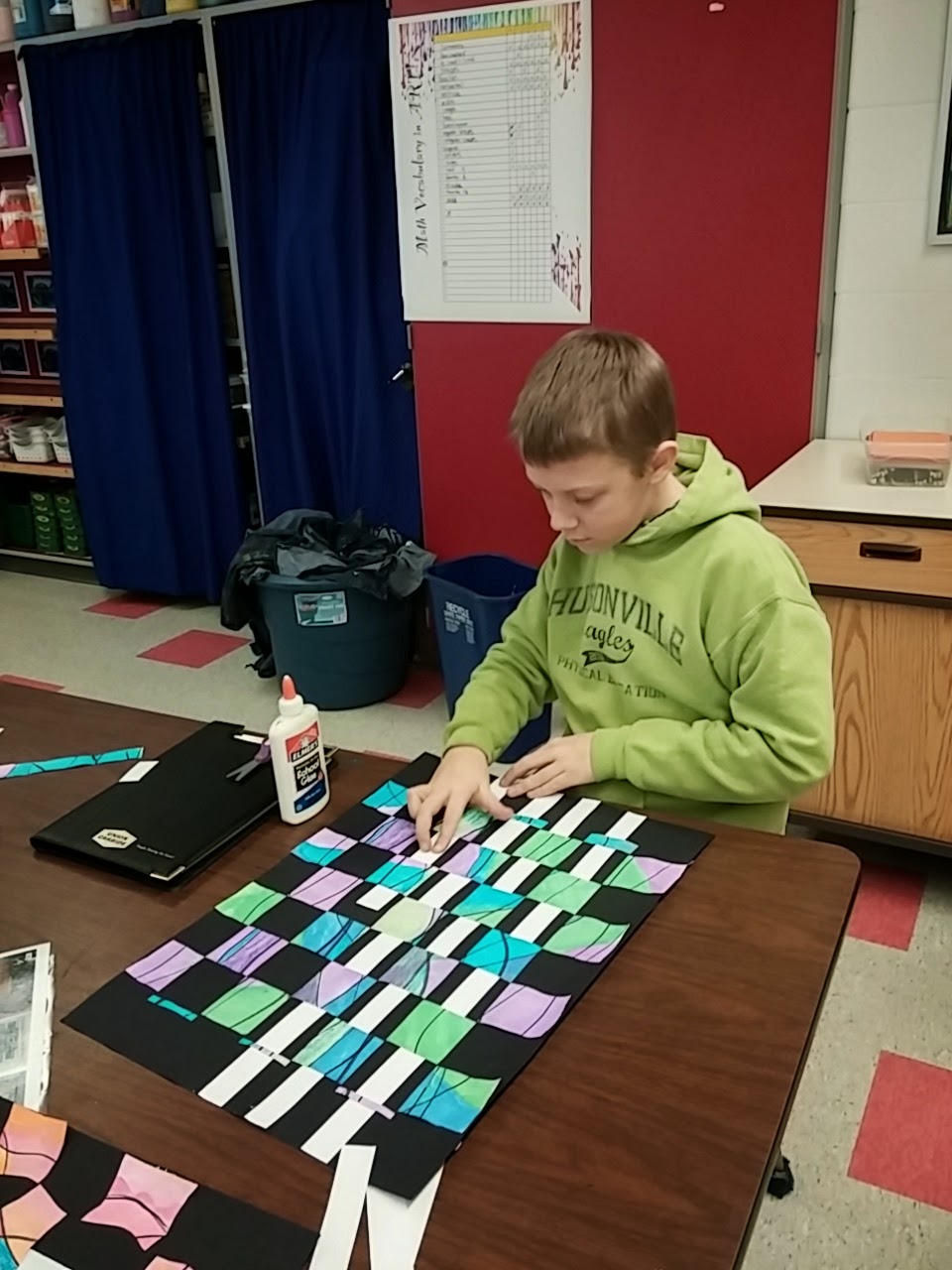
We began this project by drawing a skull and talking about how to use value and a shading technique to create the illusion of form (3D).  After making our skulls look 3D we created a special painting for weaving.  This was an abstract non-objective painting.  We talked about the difference between realistic (like a photograph) abstract (less like a photograph) and non-objective art (only lines, shapes and colors, no objects).  We created these abstract non-objective paintings to use later for weaving:


Next we talked about Navajo Native American artwork since O'Keeffe would have been exposed to it when she lived out west.  One of the art forms that the Navajo are known for is weaving.  We used our abstract paintings to create weavings.


We used the weavings as the background for our O'Keeffe skulls!


Learning Goals: I can...
- Tell about Georgia O'Keeffe
- Tell about Navajo artwork
- Create abstract non-objective art
- Create the illusion of form using a shading technique
- Demonstrate the use of pattern by weaving 


Thursday, April 2, 2015

Castles


Second graders created these fun castles! After learning a little about castles we focused on learning to make our castles look 3D.  We talked about forms (3D shapes) and we learned to draw cones, cylinders and cubes. We included these forms in our drawings.


After drawing the castles, we added value (shadows) to make our forms (3D shapes) look even more 3D. The kids learned to color lightly (grip the pencil loosely) with pencil horizontally (perpendicular with the sides of the castle tower).  After coloring lightly, they rubbed the shading vertically to blend and create shadows.


Next we practiced all kinds of characters that kids could include in their castles.  Students were encouraged to add them in wherever they wanted!


We colored the characters and small details with crayon and painted the rest!


Learning Goals: I can...
- Tell about castle building jobs: blacksmith, carpenter, mason, architect
- Explain what a form (3D shape is)
- Draw 3D shapes 
- Add value (shading) to forms to create the illusion of thickness
- Color carefully using good craftsmanship


Thursday, March 27, 2014

Warm and Cool Silhouettes


Fourth graders did a great job on these landscapes!  This was a project packed with learning goals. First we talked about color temperature.  Students learned that color choice effects how the temperature in the painting looks like it would be if we could enter it. Warm colors make a picture look warm and cool colors make it look cool. Since even the temperature in the desert can get cool at night students got to choose which subject matter they would like in their paintings: cactus or palm trees.


Next we talked about value (the lightness or darkness of a color) and used value to create radiating lines to make our light source (sun or moon) look like it glows.  Kids who wanted to create a warm color temperature mixed different values with yellow and red.  Students who wanted to create a cool color temperature used white with any one of the cool colors of purple, blue, or green.


Finally, the kids learned how to show distance with their palm tree or cactus silhouettes.  The kids learned that atmospheric perspective causes subjects in the distance to look faded.  We created this effect by using light grey in the distance.

How to show distance in artwork: (in the foreground, middle ground and background)
- Size: bigger is closer, smaller is farther
- Value: dark is closer, faded is farther
- Placement in space: lower on the page is closer, higher is in the distance
- Overlapping: the one on top is in the front

The kids were warned that the palm trees were the trickiest and required the most careful brushwork but so many of the kids were up for the challenge!  I let them practice on newsprint before painting on their background paintings. We talked about how to get smooth thin lines with paint!  This is one of the trickiest things to do with paint!


Learning Goals: I can...
- Explain how to show color temperature in artwork
- Explain what a silhouette is
- Mix to make different values
- Explain how to show distance in artwork
- Paint smooth edges.
- Identify foreground, middle ground and background.

The inspiration for this project came from here and here.

Monday, April 22, 2013

Starry Night


Second graders learned about Vincent Van Gogh and his most famous work of art, “Starry Night.”  They used oil pastels to create the impressionist brushstrokes of this famous swirling night sky.  

Learning Goals: I Can...
  • Use oil pastel to create impressionist marks
  • Use line to show movement
  • Use value to show form 


Tuesday, February 19, 2013

Picasso Blue Portraits

First graders learned about Pablo Picasso and his artwork.  We started by reading the book "Just Behave Pablo Picasso," by Jonah Winter.  I can't say enough good things about this book!  Sometimes even children's art books can be a little too much for first grade but this book did a great job of talking about Picasso's life in a way that my kids could understand.  It also provided grade level appropriate imagery that highlight the most famous works and periods in Picasso's life.  I will be buying this book for my art room library! 

The key facts we focused on for Pablo Picasso was the fact that he painted blue paintings when he was sad.  He painted rose colored paintings when he became happy again.  And, he was inspired by African masks when he started painting masklike faces.  We used 4 different values of blue for this project to remind us of Picasso's blue period.  We also created faces that look sort of like masks, in the style of Picasso.  Great job 1st grade!

Learning Goal: I can...
- Tell about Pablo Picasso
- Create a collage
- Explain what value is (the lightness or darkness of a color)
- Create texture in paint (by scratching into the wet paint)
- Use contrasting values to help facial features show up