This year our art cultural focus is Asia. Fifth grade kids created these Chinese Opera Masks! Chinese Opera masks are traditionally painted on to the actors' faces. The colors on the masks are symbolic of character traits which tells the audience something about the characters before they even speak!
After looking at these masks students created a list of common characteristics so that they would know how to make a mask in this style:
Learning Goals: I can...
- Tell about Chinese Opera Masks
- Create a mask in the style of Chinese Opera Masks
- Paint carefully!
Fourth graders learned about the art of creating a coil pot through the story, "The Pot that Juan Built." This is a fantastic story that not only shares great information about how coil pots are made but tells a wonderful story about Juan Quezada. Juan Quezada is a Mexican artist who brought his family and community out of poverty. He figured out how to make fantastic pots and taught those around him to make and sell these fine works of art!
Learning Goals: I can...
- Tell about Juan Quezada
- Create a coil pot using clay building techniques
- Paint my coil pot in a unique way
One of the 5th grade artists that we now study in Hudsonville Public Schools is Dale Chihuly a living American glass artist. It is fun for all of us to look at his unique artwork! Students learned about the different styles of art he creates such as: Chandeliers, Floats, Macchias, Seaforms and Baskets. Here is the artist's website so that you can take a peak at his art!
Classes even got to see a video of him creating art collaboratively with his team!
The kids started by using a thick dowel rod to roll slabs of clay. Then we traced the rim of some foam bowls to create smooth circles out of the clay. We gently put these circular slabs into the back of the bowl and gently used it like a slump mold taking the shape of the bowl.
Then we gently set the clay into the the bowl using the bowl like a press mold. We added ripples around the edge of the clay bowls to make them like Chihuly's Macchias and Seaforms.
After letting them dry we painted them with our best acrylic paint.
We have another collaborative Chihuly surprise coming soon!!!
Here is a video hit from our very own Fredrick Meijer Gardens about what we are up to!
Learning Goals: I can...
- Tell about Chihuly
- Tell about clay
- Use a mold to create a clay form
- Paint carefully being aware not to mix combinations of all three primary colors together.
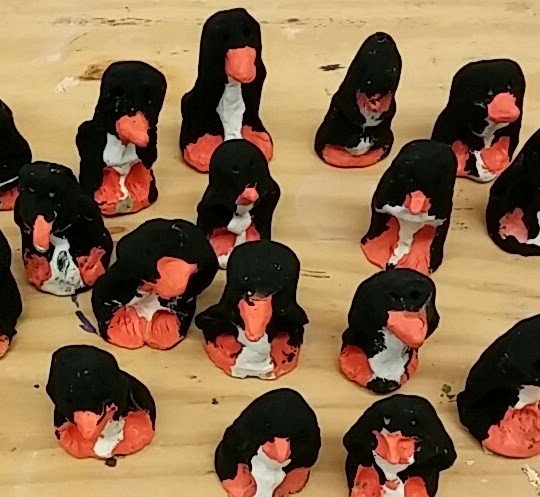
Second graders made these super cute little clay penguins. The kids started by making a smooth sphere. I compare it to a planet with no rivers (cracks) or mountains (bumps). I show them how to gently tap down the mountains and cross the rivers with a finger to smooth them out. Next, the sphere is rolled into an egg shape and the bottom is flattened so that the penguin can stand!
In second grade, the kids do clay projects that don't involve attaching pieces of clay. Instead, we focus on pinch and pull techniques to gently form the clay. We pinch and pull to create the beak, wings and feet. The clay we use is air-dry clay which can be purchased at craft stores like Hobby Lobby. (The kids always ask). It does not need to be fired in a kiln but is less durable than kiln fired clay.
Finally, after the clay air-dries, we carefully paint the little penguins with our best acrylic paint!
Goals: I can...
- Explain where clay comes from
- Create a smooth sphere
- Use push and pull techniques to form the clay sculpture
Fifth grade kids learned about Mexican masks. They compared Lucha Libre masks with Oaxacanwood carvings. Lucha Libre masks are traditional cloth freestyle wrestling masks worn by luchadores (wrestlers) in Mexico. Some of these wrestling masks are passed down from generation to generation. When a wrestling match is lost the mask is removed revealing to the community the true identity of the luchador. Then the mask is retired.
Oaxacan wood carvings on the other hand use animals as inspiration. Students who chose this style of design used bright colors and patterns in the art!
Learning Goals: I can...
- Describe Oaxacan art
- Describe Lucha Libre masks
- Use a clay slab and a slump mold to create a mask
Fifth graders looked at Aboriginal (Native Australian) art and discovered some key characteristics of Australian Art. We learned about Aboriginal dot paintings and x-ray paintings. Aborigines use dots to create implied lines and pictures. X-ray paintings are often found on cave walls. These paintings show both the outside and the inside (bones and internal organs) of the animal at the same time. Bones are typically symbolized using white lines. Fifth graders used this information as a guide for their mask making.
Learning Goals: I can...
- Describe major characteristics of Aboriginal Art (dot painting and x-ray painting)
- Describe the process for making a mask using a slab and mold
- Use symmetry to balance color
- Use dot and x-ray painting techniques
Third graders created unique animals using a pinch pot for the body. This project focused on clay vocabulary ( I can talk about my art) and techniques.
Vocabulary:
- Sculpture: a 3D artwork
- Pinch Pot: a pot created from a ball of clay using a pinching technique
- Score: to create velcro like texture in order to attach clay securely
- Slip: to add water to the clay which helps act like glue
- Smooth: to wipe away clay seams, cracks and crumbs
- Carve: to draw in the clay when adding details and textures
Learning Goals: I can...
- Talk about my artwork
- Explain the process of creating my artwork
- Use good clay craftsmanship so that my artwork holds together well (score/ slip/ smooth)
- Create a unique animal
Fourth graders created birds using a slab of clay. This project focused on clay vocabulary ( I can talk about my art) and techniques. I discovered the inspiration for this project on Pinterest! Students did a great job on this project!
Vocabulary:
- Sculpture: a 3D artwork
- Slab: a flat piece of clay
- Score: to create velcro like texture in order to attach clay securely
- Slip: to add water to the clay which helps act like glue
- Smooth: to wipe away clay seams, cracks and crumbs
- Carve: to draw in the clay when adding details and textures
Learning Goals: I can...
- Talk about my artwork
- Explain the process of creating my artwork
- Use good clay craftsmanship so that my artwork holds together well (score/ slip/ smooth)