Showing posts with label cool colors. Show all posts

Friday, January 22, 2016

Kindergarten Color Studies


Because color and groups of color are so important in art, we start kindergarten art with the color families. Older kids revisit these families often!


Rainbow Colors: We started this year with "Rainbow Turtles." This project helped us learn rainbow order which gives us the context for all of the following color families! (The warm colors are the first part of the rainbow the cool colors are the last one.  Once students know their primary colors they can figure out how to make the secondary colors because the secondaries are sandwiched in between the primaries!)

Warm Colors: The "Warm Sun" projects helps kids to visualize which colors are the warm colors. We also talk about that if we were able to "magically" go into the painting the temperature (created by the colors) looks like it would feel warm in the picture.

Cool Colors: The "Cool Landscape" project gives us the opportunity to link cool colors with the cool temperature of mountains, grass and water.

Neutral Colors: "Neutral Night Owls" focuses on the colors that are missing from the rainbow: Brown, grey, white and black!

Primary Colors: The "Primary Popsicles" project is the project were we start talking about what colors

Secondary Colors: "Mouse Paint" is a great story for color mixing! I use this story to focus on the the secondary colors!

Thursday, February 5, 2015

Chihuly Chandelier

This year fifth grade students learned about Chihuly and made sea-form bowls out of clay inspired by Chihuly.  To learn about the American glass artist Dale Chihuly check out this other blog post from when we made clay Chihuly bowls!

Each year, fifth grade students create a collaborative piece of art to donate to the school.  This year I decided to tackle the Chihuly Chandelier project with the kids! Here is a picture of one of Chihuly's glass chandeliers!


We started by coloring around 140 plastic bottles with permanent markers.  The kids were asked to design each bottle however they wanted as long as they were using only one color family:

Warm Colors: Red, yellow, orange, pink
or
Cool Colors: Blue, green, purple


After the bottles were colored, each class cut their bottles into spirals.  We started by "nipping" a hole at the bottom of the bottle and then spiral cutting up the side.  We cut off the bottoms and tossed them. If the spiral cut turned out too thick the kids went back and cut more parallel spirals which turned it into a double spiral... or more depending on how many spirals were cut! 


After cutting spirals we made 5 bottle strings grouped by color family.  We screwed the caps onto the sting to make connecting them easy!


I drilled holes at the top of a 4 foot PVC pipe for hanging...


I also drilled and stitched through some holes at the bottom of the pipe (kids helped with the stitching).

We tied a couple strands of 5 bottles to each level of pole string.  Once we got thought the first few stings on the pole we started simply tying the strings of 5 bottles around the entire diameter of the pole and pushed them down as we went until we had all the bottles attached!


I just had to post about this before it hangs in its final place!! Great work kids!!

Learning Goals: I can...
- Work collaboratively with others to create art for my school community 
- Create art in the style of Chihuly
- Created recycled art
- Use a warm or cool color scheme


Monday, October 13, 2014

Heather Galler Self-Portraits

Fourth graders made these neat Heather Galler self-portraits.


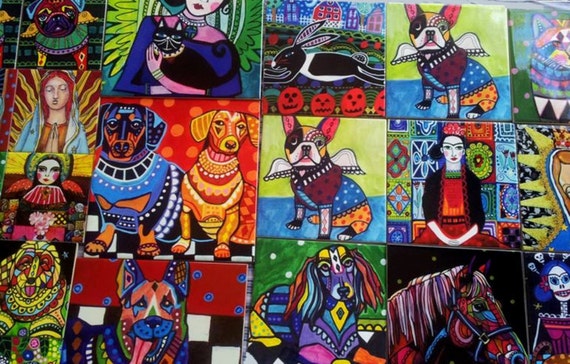
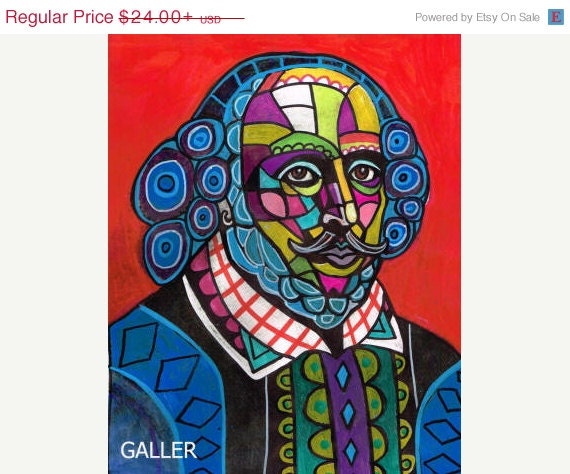
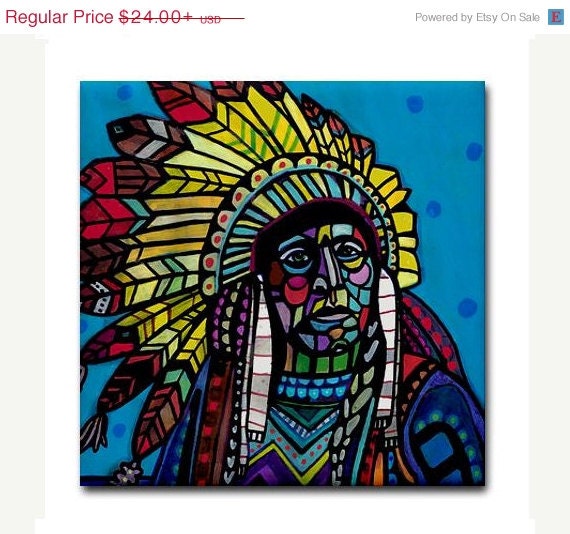
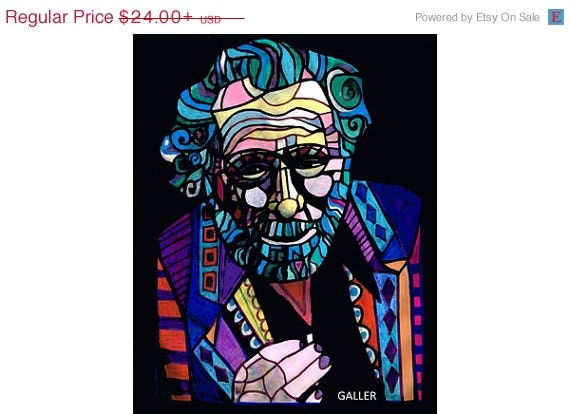
We learned about Etsy, a website were artists can sell their artwork and keep a better percentage of the profits than selling some of the same art in an art gallery.  Buying art on Etsy is a great way to support artists directly. Here is Heather Galler's popular Etsy page!  We talked about the characteristics and subject matter that Galler uses.

Here is some of her art:


50% OFF - SALE ENDING - Shakespeare Art Poster Print of Painting by Heather Galler Abstract Author Writer Play 50% OFF - American Indian Chief Art Tile Ceramic Coaster Print of painting by Heather Galler Abstract Portrait 50% OFF - Charles Bukowski Art print poster Heather Galler Modern Abstract Portrait Famous Writer author

In order to create our own Galler style self-portraits, we first traced the outlines of our facial features onto a photograph with colored pencil.  We talked about more realistic ways to draw facial features.

Next, we sharpied the outlines onto a plastic transparency.  Finally, students were encouraged to color their artwork in the style of Galler including many colors and shapes.  Students used a color scheme of warm colors and cool colors. In order to create contrast, students planned were to put groups of warm or cool colors. Enjoy!


Goals: I can...
- Explain what Etsy is
- Tell about Heather Galler's artwork
- Create a self-portrait in the style of Heather Galler
- Explain what a self-portrait is


Thursday, March 27, 2014

Warm and Cool Silhouettes


Fourth graders did a great job on these landscapes!  This was a project packed with learning goals. First we talked about color temperature.  Students learned that color choice effects how the temperature in the painting looks like it would be if we could enter it. Warm colors make a picture look warm and cool colors make it look cool. Since even the temperature in the desert can get cool at night students got to choose which subject matter they would like in their paintings: cactus or palm trees.


Next we talked about value (the lightness or darkness of a color) and used value to create radiating lines to make our light source (sun or moon) look like it glows.  Kids who wanted to create a warm color temperature mixed different values with yellow and red.  Students who wanted to create a cool color temperature used white with any one of the cool colors of purple, blue, or green.


Finally, the kids learned how to show distance with their palm tree or cactus silhouettes.  The kids learned that atmospheric perspective causes subjects in the distance to look faded.  We created this effect by using light grey in the distance.

How to show distance in artwork: (in the foreground, middle ground and background)
- Size: bigger is closer, smaller is farther
- Value: dark is closer, faded is farther
- Placement in space: lower on the page is closer, higher is in the distance
- Overlapping: the one on top is in the front

The kids were warned that the palm trees were the trickiest and required the most careful brushwork but so many of the kids were up for the challenge!  I let them practice on newsprint before painting on their background paintings. We talked about how to get smooth thin lines with paint!  This is one of the trickiest things to do with paint!


Learning Goals: I can...
- Explain how to show color temperature in artwork
- Explain what a silhouette is
- Mix to make different values
- Explain how to show distance in artwork
- Paint smooth edges.
- Identify foreground, middle ground and background.

The inspiration for this project came from here and here.

Monday, November 12, 2012

Monet

First graders learned about the artist Claude Monet and created a seascape in an impressionistic style.  We used loose overlapping brushstrokes to imitate Monet's style.  Monet was an artist who loved to paint outside and he especially liked water scenes!

Learning Goals: The learner will...
- talk about Monet's artwork
- paint in the style of Monet
- use warm colors in the sky and cool colors in the water
- use size to show space (the boats are smaller in the distance and larger closeup)


Monday, October 29, 2012

Cool Landscape


Kindergarteners have been learning about the color wheel.  For this project we looked at the cool color family and created our cool landscapes using only the cool colors, purple, blue and green.  We noticed that all of the cool colors are on one side of the color wheel!  The warm colors from last time were on the opposite side.  We also learned that a landscape is always a picture of land!

Learning Goal: I can pick out the cool colors.   We began by linking cool colors to parts of a landscape that are actually cool to the touch.  Green grass can cool your feet off on a hot summer day.  Blue water is great to swim in if you want to cool off!  We also learned about how mountains are cooler as you walk higher towards the snowcaps!