Showing posts with label abstract. Show all posts

Friday, June 2, 2017

Fifth Grade Digital Art


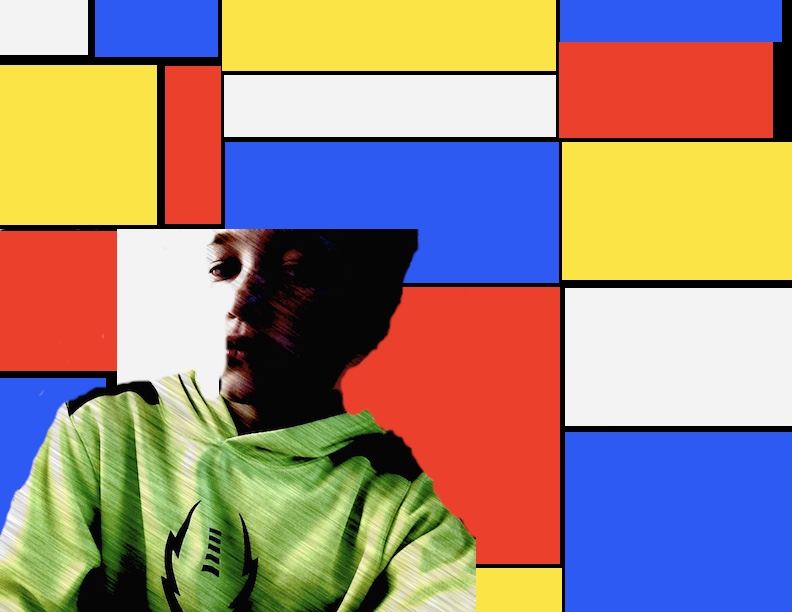
Fifth grade used the program "Acorn" to create their own versions of a famous abstract work of art. They were given access to a shared google folder that had folders dedicated to a variety of artists that they have learned about over the years and their famous works of art. Next they set to work learning to use Acorn (similar to Photoshop).

Acorn is a simplified (and somewhat glitchy) version of Photoshop. I really liked using this with my older students because it is so close to Photoshop that I feel like they are getting something of a real world experience.


Learning Goals: I can...
- Create a file in Acorn that is US Letter sized
- Use Google Drive to download a famous work of art from a shared folder
- Use Preview to open the famous work of art and to pick colors from the original artwork
- Use Acorn tools and modify size and opacity: Paintbrush, bucket, smudge, eraser, eyedropper
- Use Photo Booth to take a picture and insert it into Acorn
- Use layers and change visibility
- Convert Acorn file to JPEG
- Drop JPEG into a shared google folder to submit it to Mrs. Seitz

Tuesday, April 28, 2015

O'Keeffe Skulls


Fifth grade students study Georgia O'Keeffe each year.  She became a famous American artist during a time when only men were supposed to be artists. She is known for her large flower paintings and paintings of skulls.  She regularly zoomed in on her subjects which often made her artwork look abstract. Here are some examples of her artwork:


We began this project by drawing a skull and talking about how to use value and a shading technique to create the illusion of form (3D).  After making our skulls look 3D we created a special painting for weaving.  This was an abstract non-objective painting.  We talked about the difference between realistic (like a photograph) abstract (less like a photograph) and non-objective art (only lines, shapes and colors, no objects).  We created these abstract non-objective paintings to use later for weaving:


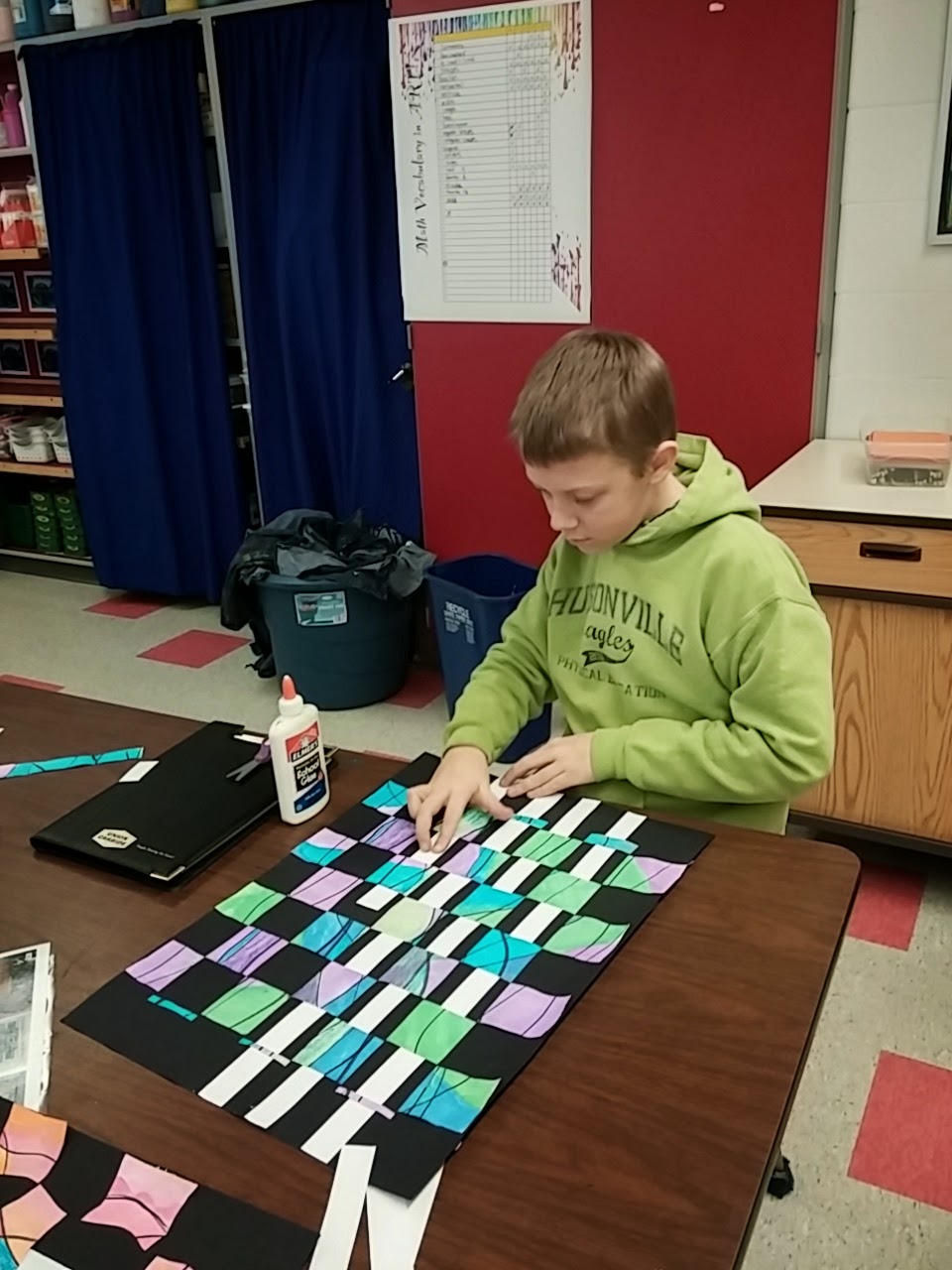
Next we talked about Navajo Native American artwork since O'Keeffe would have been exposed to it when she lived out west.  One of the art forms that the Navajo are known for is weaving.  We used our abstract paintings to create weavings.


We used the weavings as the background for our O'Keeffe skulls!


Learning Goals: I can...
- Tell about Georgia O'Keeffe
- Tell about Navajo artwork
- Create abstract non-objective art
- Create the illusion of form using a shading technique
- Demonstrate the use of pattern by weaving 


Thursday, March 5, 2015

Abstract Circles

Second graders did a quick project on abstract painting.  We talked about the difference between abstract and realistic.  At the most extreme end of abstract art we have non-objective art.  This project would fall into this category because there is not even a hidden picture camouflaged by shapes and colors.


When we painted our acrylic circle paintings with watercolor we talked about color relationships.  We learned that if all 3 of the primary colors (red, yellow, blue) are present in a mixture then the color turns brownish.

To illustrate this concept did some MATH! We simplified equations:

R+Y+B =Brown: this equation can be simplified the following ways:

Mixing Complimentary Colors (opposites)

O+B=Brown
G+R=Brown
P+Y=Brown

We also expanded equations and discovered that all 3 of the primaries were present in these secondary mixtures:

G+P=Brown becomes Y+B+B+R= Brown
O+G= Brown becomes Y+R+Y+G=Brown

When blending our watercolor paint we tried to avoid the above combinations!

Students learned that they can play it safe by blending analogous colors (colors that are right next to each other on the color wheel).  These color combinations always involve only 2 primary colors!

Learning Goals: I can...
- Tell the difference between abstract and realistic
- Blend colors and avoid a muddy look (brownish)

Wednesday, January 28, 2015

Kandinsky Instruments


Wassily Kandinsky was the inspiration for these colorful 4th grade paintings!  In order to learn about Kandinsky we read "The Noisy Paint Box." Wow, this is an awesome book that really gave the kids a better idea of who Kandinsky was.


The kids learned that he was an artist with synesthesia. A condition in the brain where color and sound are connected.  Kandinsky could hear color as music, and see color when listening to music. He is also considered to be the father of abstract art.  We combined the theme of music with an abstract background full of shapes and colors.

First we practiced drawing the instruments on the back of our paper.  Then we turned the instruments into a composition of 3-4 instruments with at least one pair overlapping. 


After drawing final compositions onto the front of their papers, students did a serious study of the color wheel... complete with pre and post test.  In addition to mixing their own colors, students were also asked to connect color mixing with math and fractions!

Here is a sample of the way we approached color mixing with math:


Color mixing is a practical application for fractions.  If you don't use the right proportions of each color you just don't get the exact color that you want!  For instance, when making green, if you use too much blue (a dark, powerful color) it's very hard to add enough yellow (a light, weak color) to create green.  The kids were asked to remember to use two double scoops of the lightest color (4/5) and one tiny dab of the darkest color (1/5).  We used these measurements as guidelines.  The kids also learned the difference between indigo and violet (indigo is mostly blue while violet is closer to red on the color wheel.  When you combine them you get purple).  

Each student mixed their own colors on a color wheel worksheet (painters palette):

Students used popsicle sticks (our makeshift serving spoons) to scoop the primary colors out of the paint trays and onto their mixing worksheets. Then they used their brushes to do all the mixing on the sheet.  This was the first project that I have used this method for, and I loved being able to have ALL the kids in charge of making ALL of their own colors!  Whenever they ran out of a secondary color they had to problem solve to match the original color again! I think this helped the kids learn the color wheel very well. 


We started with only primary colors...


Then the kids added their secondary color mixtures.  The kids tried not to have shapes of a like color touching.  This created even more problems to solve!


This was a project with so many layers of learning and problem solving! It is definitely one I will use in the coming years!

We wrote a simplified version of the learning goals listed below on the back of our art for parents to see what we're learning!

Learning Goals: I can...
- Tell about Kandinsky
- Create and abstract background using regular and irregular shapes
- Create a composition with at least one set of overlapping instruments
- Name the primary and secondary colors
- Use fractions to communicate how to mix primary colors to make secondary colors
- Explain the difference between indigo and violet
- Use good craftsmanship when painting smooth edges and outlines
- Create contrast (as opposed to camouflage) by using different colors in shapes that share a side


Monday, December 15, 2014

Klee Shape Faces


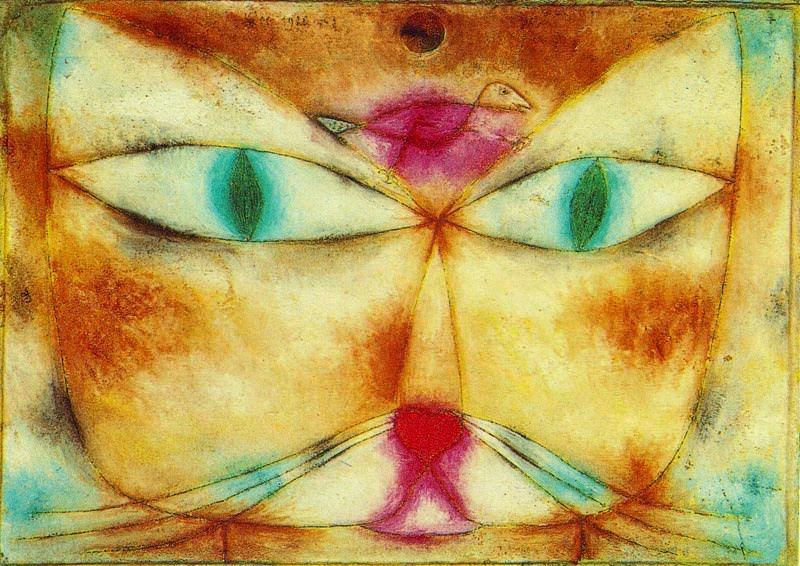
Kindergarteners created art in the style of Paul Klee.  We read "The Cat and the Bird: A Children's Book inspired by Paul Klee" and we looked at the actual painting by Klee titled "The Cat and the Bird."  We talked about abstract art (art that doesn't look as real as a photograph) and how some abstract artists like Klee like to use lots of shapes in their artwork.  For this project we focused on learning the difference between a line and a shape.  Then we moved on to the difference between regular (geometric) and irregular (organic) shapes.


On the first day, we drew and sharpied dog or cat faces.  Since I'm a real dog lover I couldn't help but give the kids a choice.  When I have done this project in the past, I have focused on the painting "Senecio" by Klee but I must admit drawing animals is a little more fun!


The next day, we painted using warm colors since Klee focused on the warm colors in his paintings. When we paint with the warm colors, we start with the lightest warm colors and work our way to the darkest colors so that the water doesn't get to dirty for the yellow right away.  I try to pick the yellow up early on so that it doesn't get too messy! Students were challenged to avoid painting shapes that were touching (sharing sides) with the same color.  Some exceptions had to be made at the end when we ran out of colors.


Learning Goals: I can...
- Create abstract artwork in the style of Klee
- Tell the difference between a regular and irregular shape
- Balance colors throughout my artwork
- Use good craftsmanship when drawing and painting